A candidate challenges a rejection
They write that they meet the requirement even though their application was rejected. You compare the question and the answer with the requirement and decide whether to have the application analysed anyway.
You’ll practise supervising the virtual recruiter. You’ll check what it based its rating on, decide whether you agree and learn when to call a halt. At the end, you’ll receive a certificate of completion, a whistle and a badge.
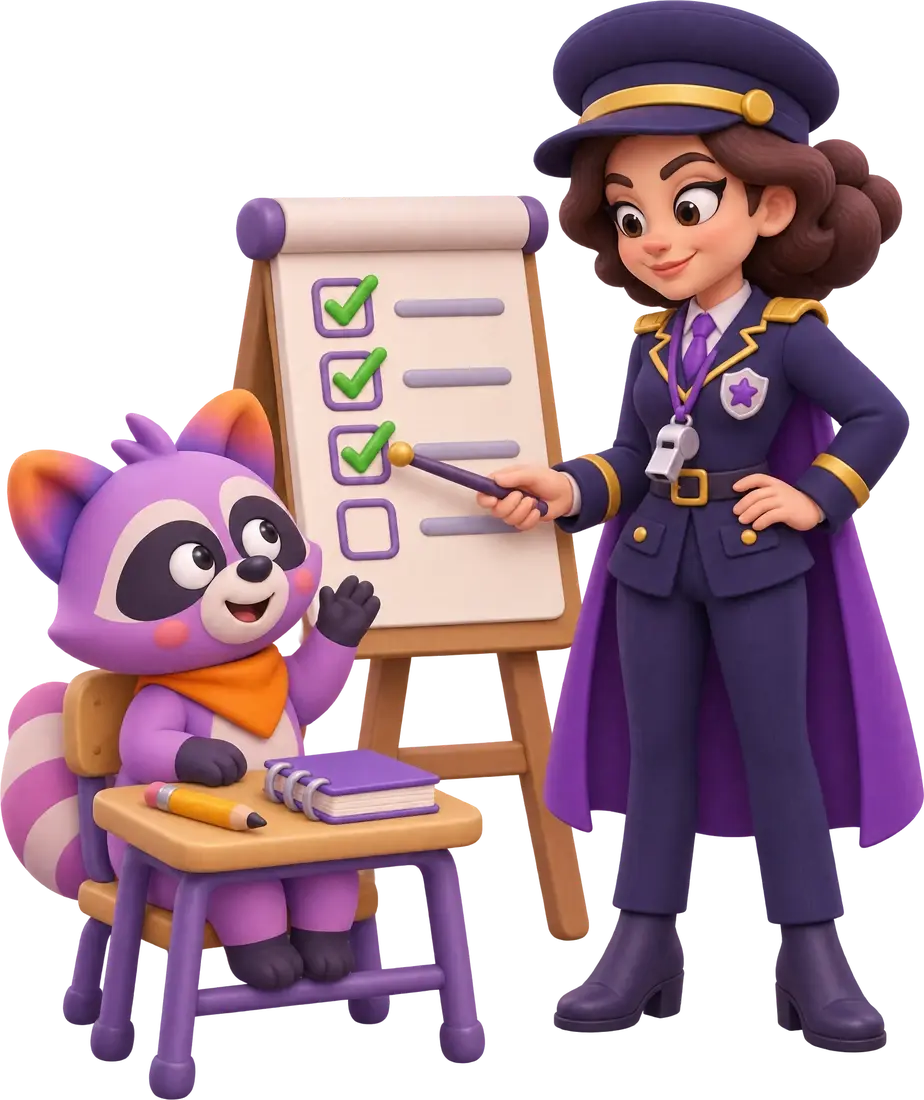
For example, a recruiter, an HR business partner or another colleague who works on recruiting in your organisation.
You don’t need a background in machine learning. You do need to know how recruiting works in your organisation and whether a requirement is really needed for the job.
Supervision requires the ReCops role in the app. It lets you override a rating and undo a decision. Without it, you can only watch.
During the pilot, our ReCops team supervises the virtual recruiter. The person you choose completes the training before making decisions in the app on their own.
Why there is a person in the process, when Article 22 of the GDPR applies and why just clicking “approve” is not supervision.
You set the requirements. AI uses them to draft the questions in the form, and a simple rule checks the answers. An application closes automatically if an answer shows that the candidate does not meet a must-have requirement.
Four lists: Fit, Maybe, Not fit and Rejected. After an assessment, AI can only propose a rejection. The candidate is not rejected until a person approves it. You’ll practise approving a rejection, giving a candidate a chance, overriding a rating and undoing a decision.
You’ll check which requirement the form question tested, what answer was expected and how the candidate answered.
How models make mistakes and why it is so easy to start approving without reading.
How to spot requirements that may indirectly discriminate. You’ll learn when candidates have the right to a check by a person and when they are entitled to an explanation of the role AI played.
You’ll work through five recruiting situations as a group and discuss them with the trainer.
You’ll complete the checklist and sign to confirm that you have reviewed the training materials. There is no exam and no score.
You’ll trace what AI assesses, what a rule checks in the form and when a person decides.
You’ll compare them with the CV or with what the candidate said during the call.
You’ll check whether a requirement is needed for the job and whether the form question reflects it well.
You’ll approve a rejection, give a candidate a chance or have a rejected application analysed, and say why.
You’ll practise answering a request for an explanation or for a person to check the decision.
You’ll discuss what to report to us and when to stop using the system.
They write that they meet the requirement even though their application was rejected. You compare the question and the answer with the requirement and decide whether to have the application analysed anyway.
AI gives a candidate a high rating, but the CV does not support the reasons it gives. The rating alone is not enough to move on. You report the discrepancy to us.
The hiring manager writes “no gaps in employment”. You flag it before recruiting starts and explain who it could exclude.
The job requires a category B driving licence, but the form asks about a licence issued in Poland. You correct the question before recruiting starts.
The rating is low, and the transcript may have missed some of what the candidate said. You compare it with the recording and report the possible error to us.
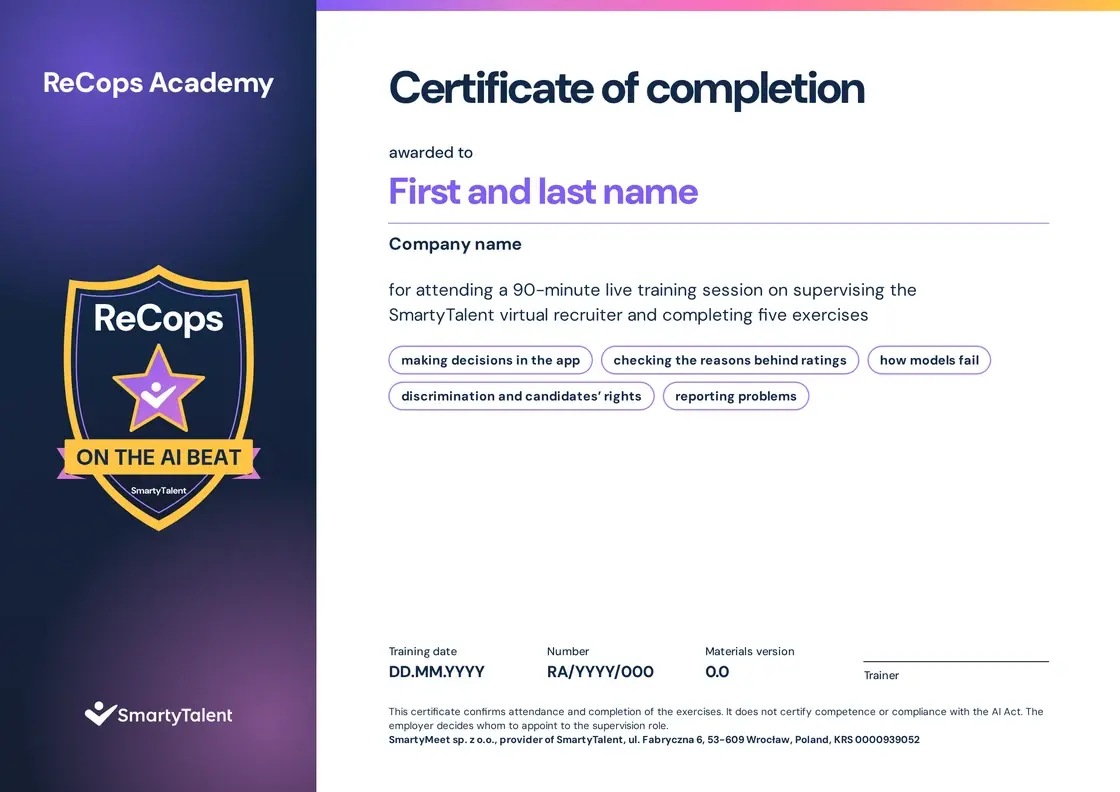
Made out in your name, in English or Polish. It confirms that you took part in the training and completed the five exercises. It does not certify competence or compliance with the AI Act.
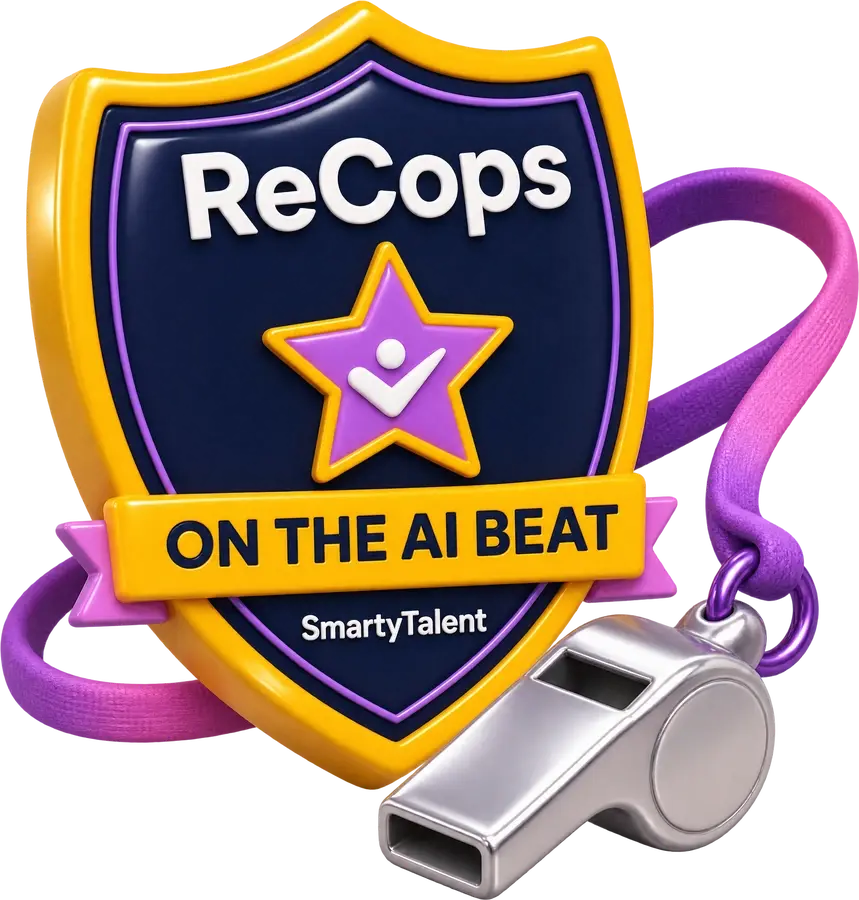
ReCops, on the AI beat. The whistle reminds you that you have the right to call a halt. The badge shows who is keeping watch.
Before a person from your team gets the ReCops role and starts making decisions in the app.
Refresher training for every person with the ReCops role.
When the model or the process changes significantly, and after an incident that has to be reported.
We design the app so that a person can check and change a result. We run the training, provide the materials and issue the certificate of completion.
You assign supervision to people with the right skills and training, give them authority and support, and keep their signed acknowledgements. The training helps you prepare for this duty (Article 26(2) of the AI Act), but it does not fulfil it for you. In recruiting, the provision applies from 2 December 2027.
What does ReCops do day to day, and how do you take over supervision? ReCops supervision →
30 minutes with Monika, co-founder of SmartyTalent. We will show an example of the virtual recruiter's work and answer your questions about the ATS integration, supervision and documents.
Book a 30-minute demo →